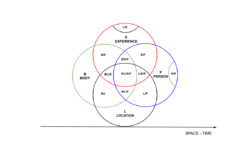
Internal / interpersonal state (I-State) and psychopathology
Fundamentally, psychopathology is a sequence of events within and across all four registers of an I-STATE.  In time, a unique internal / interpersonal configuration (position, state) develops, aspects of which are perceived (by one and others) as a maladaptive dysregulation (dis-order, impairment) of  a “normal” (typical, expected) or desired way…
Continue reading

UNIQUENESS – patterns of being and representation (relational style, identity, gender) 

Prototypical configurations of the four registers correspond to unique patterns (styles) of being and experiencing (representing) oneself and others (“identity”, “personality”) . For instance: The six prototypical [Lxxx] configurations (LBEP, LBPE, LEBP, LEPB, LPBE, LPEB) correspond to a style (pattern) focused on location, including (i) tangible proximal events (entities, things)…

Continue reading

UNIQUENESS and Personality Disorders (2020 Model)

‘Disorders of personality”   “Personality” is a neurocognitive aspect of UNIQUENESS. It underlies and regulates unique features of one’s biophysicality, cognitions, emotionality and behavior across multiple contexts and locations. “Personality Disorder” is an epigenetic neurocognitive dysregulation of personality endophenotype manifested in discrete configurations (syndromes) of phenotypic signs and experienced symptoms…

Continue reading

Uniqueness and Psychopathology

Psychopathology is (i) an expression and (ii) a study of maladaptive dysregulation (dis-order, impairment) of one’s BODY (biophysical functions, appearance, behavior) and EXPERIENCE (sensations, affects, awareness, ideation), in a PERSON among others, across multiple LOCATIONs.  It is (i) subjectively experienced and represented in one’s consciousness as symptoms; (ii) observed and…

Continue reading